
Kevin Lay (Neo Israel)
10/13/2025
Note-this is just the abstract. Full article submitted and under review in Journal of Cognition and Culture
Abstract
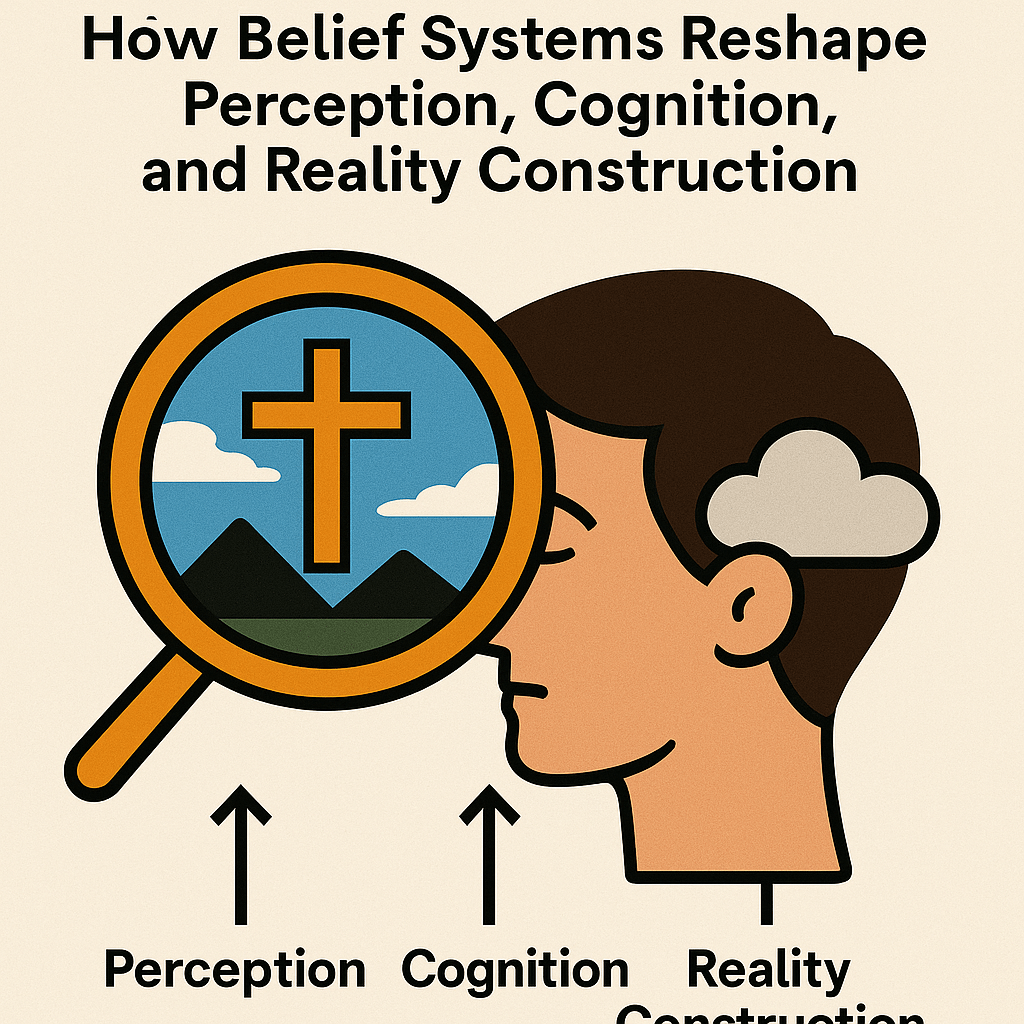
Human perception is often misunderstood as a passive process of sensing objective reality. However, decades of psychological research demonstrate that cognition actively shapes what individuals perceive, interpret, and believe to be real. This paper introduces Epistemic Lens Theory, a framework that explains how belief systems—especially religious worldviews—function as perceptual filters that modify cognitive processing from the level of sensation up through interpretation and meaning-making. Unlike models that treat belief as a purely cognitive or social construct, Epistemic Lens Theory argues that internalized worldviews alter perception itself by influencing schema-driven processing, top-down interpretation, and attention allocation. Drawing on research in sensation and perception, schema theory, cognitive biases, and socialized knowledge structures, this paper illustrates how religious doctrines such as Christianity can cause divergent interpretations of identical stimuli. For example, a Christian and a secular critical thinker may perceive the same biblical text in fundamentally different moral and emotional terms due to their epistemic conditioning. The implications of this theory extend to critical thinking education, intergroup conflict, marketing and persuasion, religious cognition, and the epistemological challenges posed by AI and the future of knowledge. Epistemic Lens Theory offers a new approach for understanding how deeply-held beliefs not only influence thought but actively construct subjective reality.
 NeoExistence Institute
Leave a comment